<body><script type="text/javascript"> function setAttributeOnload(object, attribute, val) { if(window.addEventListener) { window.addEventListener("load", function(){ object[attribute] = val; }, false); } else { window.attachEvent('onload', function(){ object[attribute] = val; }); } } </script> <iframe src="http://www.blogger.com/navbar.g?targetBlogID=25139444&amp;blogName=Mahlers+on+Safari&amp;publishMode=PUBLISH_MODE_BLOGSPOT&amp;navbarType=BLUE&amp;layoutType=CLASSIC&amp;searchRoot=http%3A%2F%2Fmahlersonsafari.blogspot.com%2Fsearch&amp;blogLocale=en_US&amp;homepageUrl=http%3A%2F%2Fmahlersonsafari.blogspot.com%2F" marginwidth="0" marginheight="0" scrolling="no" frameborder="0" height="30px" width="100%" id="navbar-iframe" allowtransparency="true" title="Blogger Navigation and Search"></iframe> <div></div>

Monday, November 23, 2009

Living While Fat - An American Crime


I am fat. I have been fat since I was 10. And while it was never a conscious decision about how to live, after years of personal struggle and self-realization I decided long ago to not let it get in the way of living fully. Which, by the way I do, probably way more than most skinny people.

Now I know that there are lots of people out there who are uncomfortable with the idea that someone as large as I can be professionally and personally successful, but I live to break the barriers of small-minded expectations. And although you may see me as fat on the outside, on the inside I have never been fat in the negative vitriolic way that we large people are expected to hate ourselves.

Which is why I’m still adjusting to the recent epiphany that fat people, like me, have become the latest government-sanctioned target for ridicule and bigotry in America.

It’s not like we haven’t been down the road of stigma and discrimination on a whole host of other issues in our ugly past before. Once upon a time Blacks were only 3/5ths the value of a White man and it was socially acceptable, and even fashionable, to call people Spicks, Fags, Kikes, Niggers, etc. It isn’t like fat kids have not been the joke of the playground since time immemorial, and it isn’t like adults supervising those playgrounds have not turned a blind eye to those particular rants – even in these days where there is sensitivity about bullying.

Is it not bad enough that people spit the word “fat” out as a curse word or derogatory marker? In this case, the word “fat” somehow emphasizes the terribleness of some other bad trait (e.g. “she is a fat slut” when really that slutty girl is not fat at all but a fat slut is worse than a regular old slut).

From my perch here in Tanzania it seems that what has changed is that fat is now an acceptable stigma for ADULTS and our very own GOVERNMENT to wield in America. And once again I am left wondering why it somehow makes us feel better about ourselves to put other people down for the things we fear the most. Like somehow the very presence of a fat person highlights all the insecurities we have about our own bodies – or something bigger - like the national debt.

And to make it worse, it is my own people – fellow public health professionals – that are leading the completely misguided assault on fat people. It seems that now that we’ve largely won the war on cigarettes the public health mafia needs a new place to turn their attentions.

Don’t get me wrong, it is not misguided to educate people about healthier behaviors and pitch to them the reasons why they should change, and to give them step-by-step guidance for how to make those changes. And it is not wrong to worry about the burden of obesity’s (as well as a whole long list of unhealthy behaviors) effect on our society. But in their overzealousness, my public health sisters and brothers are attacking the people who are fat rather than coming up with creative ways to deal with the undesirable behaviors or seeking to understand the true reasons why most seriously overweight people are overweight - which in my somewhat experienced opinion is really due to a complex mix of psychological and metabolic factors rather than simply too much McDonalds or Kentucky Fried Chicken.

Which leads me to why it is that I am up at nearly 2 AM on a Sunday night/Monday morning, writing about fat stigma, with my blood boiling and my face turning purple with rage. Well… it is the fault of the BBC. At 11 PM I listened to an interview with the head of student health from Lincoln University in Philadelphia describe why it is that the university plans to prevent almost 80 students with BMIs of over 30 from graduating unless they take a special fitness and health education class for obese students only. And to make it worse, arguing with an editor from the student newspaper who categorized the classes as offensive and inconsequential to the degree programs that students have completed, the BBC commentator countered that the university should even reconsider investing in fat students at all since probably not long after they graduate they will just get sick and be a burden to society, and therefore a wasted education.

WTF?

When did it become fashionable again to deny a person an education because of their outside casing? Are students who smoke, drink, take drugs, have a family history of cancer, or have unprotected sex being subjected to special classes? Are they being told that because they may eventually be a burden to society they, too, should be divested of the degrees which they have spent four years earning?

I hope those students sue the ass off that school. I will be the first in line to contribute to the legal fund.

And this leads me to ask, whatever happened to loving the sinner but hating the sin?

The truth is that when stigma increases, the ability and willingness of people to seek help for that stigmatized issue decreases. I see it all the time in my work where people living with HIV in communities where stigma is high end up denying themselves access to treatments and support that might help them live longer and put others at less risk because the social risks of seeking help are too high. Where stigma decreases, communities are better able to cope. It is in communities where the partnership between people with the disease and their friends and neighbors without the disease work together that we have seen the best successes in curbing the spread of HIV.

It is frankly the same with fat people. The more the society around us seeks to stigmatize us, the less likely we are to feel comfortable interacting with the rest of the world, taking that exercise walk around the block, or seeking the medical assistance we need to stay as healthy as possible. Think about how unpleasant it can be to visit a new medical provider when you aren’t overweight. Then imagine what it must be like for someone who is significantly overweight to get weighed (and inevitably judged) by a stranger, be given a medical gown that doesn’t fit, meet with a new doctor who is more likely to lecture than counsel, and share your body – which you are not very comfortable in – with that lecturing stranger. It can be agonizing, demoralizing and stigma enhancing.

Here in Tanzania I have become sick of opening up my MSN every morning to read another article about the fat tax on fattening foods, airlines denying seats to fat people with the happy approval of the rest of the country, or health insurance companies using fat as a preexisting condition to deny coverage to people who are even barely overweight. I don’t care if skinny Americans, are slightly put out by the very presence of fat people. For me their discomfort isn’t all that different than how some people 60 years ago didn’t want to have to ride the bus with Colored folks. Tough shit. The world is diverse, and not everyone can or should look like Heidi Klum.

Fat is a human rights issue. Stigmatizing me and my kind will not make America skinnier. It will just make us unhappier, more divided, and angrier. And by the way, none of these conditions are particularly conducive to weight loss.
**** Edited to remove a snarky comment about people doing coke to stay thin. I was trying to be ironic, but I think it just got in the way of my message.

Tuesday, November 03, 2009

My Third Culture Kids

Rowan in her Obama kanga

Friday was International Day at the International School of Tanganyika - meaning that kids were to come to school dressed in their “national costume”, participate in a parade of nations (by nationality), sing songs about peace and multiculturalism in an assembly, and attend the International Festival where kids were to talk around to different areas of the football field visiting different countries to learn something new, taste a bit of their food, and get their special “passports” stamped.

I’m normally horribly cynical about this sort of thing – but since the election last year this has largely changed. I was happy to dress in red, white, and blue and march in the parade with my kids – who like a huge chunk of the American contingent were decked out in Barack Obama t-shirts. Rowan even wore a specially made Obama dress for the occasion. For me, walking with the Obamaians, and a scattering of cowboys and cowgirls (and even one Native American) was a joyful experience.

It was a reminder of just how multicultural this environment really is. Personally, I was shocked with the relatively small size of the American marchers. I expected them to take up a disproportionate portion of the crowd, but really they weren’t much bigger than then South Africans or the British, and may have even been smaller than the Indian contingent (which were of course the most beautifully dressed of the lot).

Inside the assembly, kids from South Asia, Japan and Kenya performed for the audience in between courses of Give Peace a Chance and a song called In This World Together (a poem, of sorts, about living in peace and protecting the earth). The Principal reminded the kids and gathered parents that many kids had a choice to make about which country they wanted to represent in the parade. Some kids marched with the country they were born in, some where their passport is from, some were they lived the longest, and some marched in the country of one parent, but not the other. And those that couldn’t decide marched with the “UN” contingent which also included “orphans” from countries where there were only one or two representatives like Luxemburg or Nepal.

And since I’m so sappy, I fell for the beautiful One World image:

Living together in peace
Protecting the earth
Fighting against poverty and injustice
And beautiful babies and chirping birds, la de da de da…


I may have been so in the moment that I actually shed a tear of joy when the South Asian contingent of India, Pakistan and Sri Lanka pointed out that they made a conscientious decision to perform together – to show how people can live in peace.

It was only later that the downside of multiculturalism truly hit me in the face. At the festival part of International Day children were given a passport and told to visit booths from about 20 countries. In each booth the children could learn something about the country and get a treat or a small present somehow related to the country. I worked at the American booth as the passport stamper. In return for a tidbit about America (“Tell me something you know about America”) I stamped the kids’ passports and gave them a homemade chocolate chip cookie (made by little American Mommy elves and/or their cooks). It was mostly a happy task, except for the two older boys who claimed their chocolate chip cookies in exchange for information about how many people died on 9/11 when the planes hit the World Trade Towers – while wearing big smiles. That wasn’t such a nice moment. I’ve decided to blame it on their parents who must not be raising them under the banner of multiculturalism, rather than the kids themselves. At least that is what I needed to tell myself in order to get through the moment without taking them to task.

But overall it went great. Several hundred children from age 3 to 11 came by the American booth that day and I would say about 80% of them – no matter what their country of origin - told me that Barack Obama is the American President in exchange for their stamp and cookie. After awhile that got pretty boring so I started to challenge the American kids to tell me at least one other thing they knew about America.

Let me tell you, the answer is, not much. Well… one older kid impressed me with the knowledge that there were 13 states when America was first created and another told me that the bald eagle is our national bird. But then I looked up and realized that these tidbits were in the booth display behind them. I asked one 10-year-old American kid if he had ever heard of the Pilgrims. The silence was deafening.

My kids, they couldn’t do any better. When I asked them a few days before International Day what America meant to them Rowan responded that it meant Grandma’s house and the Good Humor Man. Jaden said Toys R Us and escalators. Barack Obama is what they know. Even the American flag is Barack Obama’s flag in their lexicon.

I take full credit for this failure. I should be supplementing the multiculturalism with some sort of identity-strengthening learning and I haven’t. Bad me. Now I’m wishing I could send the kids to an after-school American class where someone else could make up for my shortfalls (like having my Microsoft Word set to British English at work) with stories about the Mayflower and Jamestown. At least then they would know what American football is. (To-date they have no clue.) And perhaps they could help Rowan with her absolute obsession with wanting to be Indian (dot, not feather) which is primarily an obsession with wanting to wear colorful saris and salwar khamises. And perhaps the school could help get rid of the Britishisms that have sneaked into their daily language, like saying sitting room instead of living room, nappies instead of diapers, and pronouncing naughty like noughty. These aren’t a big deal now, but if the experiences of my adult friends who grew up overseas are any indication, it will make them freaks when they get back to school in America. And depending on how old they are when we go back, it could be a traumatic experience.

Although we’ve been here for nearly four years, it is only now that it has really hit home that I am raising third culture kids. Or rather, intellectually I knew it was happening, but my work as a US immigration officer at International Day prompted me to internalize it.

And don’t get me wrong, this is NOT a bad thing. There are some many wonderful things about multiculturalism (see above). But it isn’t all roses and cream either.

According to the bible of third culture kids: Third Culture Kids: The Experience of Growing Up Among Worlds by David C. Pollock and Ruth E. Van Reken,

“A Third Culture Kid (TCK) is a person who has spent a significant part of his or her developmental years outside the parents’ culture. The TCK builds relationships to all of the cultures, while not having full ownership of any. Although elements from each culture are assimilated into the TCK’s life experiences, the sense of belonging is in relationship to others of similar background.

“Two realities arch over TCK experience that shape their lives. These are:

1. Being raised in a genuinely cross-cultural world.
2. Being raised in a highly mobile world

“Other characteristics in common:

Distinct differences. Many TCKs are raised where being physically different from those around them is a major aspect of their identity.

Expected repatriation. Unlike immigrants, third culture families usually expect at some point to return permanently to live in their home country.

Privileged lifestyle. Historically TCKs are members of an elitist community – one with special privileges bestowed on its members.

System identity. Members of specific third culture communities may be more directly conscious than peers at home of representing something greater than themselves.

This definition very accurately reflects the realities are our lives now – with all the wonderful exposures they offer us, and all the losses of friends and cultural fluency ahead of us.
I love it and hate it, all at the same time. I still wouldn’t trade this experience for all the acculturation in the world. I hope that Jaden and Rowan will agree when they are old enough to realize what they’ve gained and what they may have lost.

Meanwhile, I’m trolling amazon.com for children’s books about the Pilgrims and George Washington. I want them to be people of the world. But they are also Americans and I need to make sure they are proud of that, too.

Monday, September 28, 2009

And for the Sins of Disconnection…

It is Yom Kippur and in Dar es Salaam there is no Chabad visit this year and I have no synagogue in which to pray (or think, in my case). So instead I am at home, still in my pajamas, still in bed, not quite off the grid…. Reflecting.

Every year between Rosh Hashanah and Yom Kippur I try to make a ritual of making right whatever I might have made wrong during the year – not really with God, but with the people I may have slighted/hurt/ignored/disrespected, etc. This year doesn't particularly stand out as a year in which I've behaved poorly or particularly well. It is just another year and I am an average schmo with average offenses.

Yet this year I have been feeling particularly melancholy – and not only since this season of reflection has begun. I began feeling this way back before I went on home leave; and if anything home leave made it worse for me – highlighting in bright marquee a sentiment that had been steadily building.

I'm feeling disconnected.

I am one of those people who thinks of herself as a friend for life. I still have a large handful of friends from when I was in Kindergarten – and quite a few from even before that. I've always connected and collected friends – most in the places where I've lived – but lots whom I got to know through my work/travels/special interests. I like being a friend. I like having friends. I like keeping friends. It is sort of a hobby of mine.

Being currently unpartnered in life, those friendships matter even more. Without the benefit of a partner, who would be a natural witness to my life, friends are my lifeline, my memory, my intimacy, and more. I value them. If you are my friend, I value you greatly.

Having been in Tanzania nearly four years now I have lots of wonderful friends that I value very much. I am really a very lucky person. But it is my childhood/young adulthood friends still back in the US (for the most part) who have witnessed the majority of my life (my life before children) that I find myself longing for this Yom Kippur day.

After four years of living apart – I feel some key relationships slipping. Or maybe, it is not really the relationships that are slipping, but rather the intensity of how they are experienced. Ever since I was on home leave this feeling has been in the background of my emotional life, and I don't like it much. I was warmly welcomed back to the US by my friends, but after getting together once or twice they were back to the lives that they are now living without me present on a regular basis. It made me feel sad, although intellectually it makes perfect sense.

And I think that these feelings have been intensified because my longtime (pre-TZ and current-TZ) friend, Jane, has been out of the country for the past three months on medical leave. (Heal quickly and come back soon, please.) With her gone, my day-to-day witness is gone, too.

And of course, I have very much played a role in increasing my disconnection. Facebook and blog posts do NOT create community. I may know that my friend is eating baloney on rye with Cool Whip for lunch, but that doesn't create emotional intimacy between us. You may know that I spend my Sundays at a beautiful pool on a cliff overlooking the Indian Ocean… but that doesn't tell you that I'm feeling melancholy. (And frankly, I would never use Facebook to do that. I have unfriended quite a few people who only whine about how unhappy they are on their Facebook posts. (Hmmm… kind of like I'm doing in this post?) I have my own problems, I don't need to hear about their shit as well. (Special exceptions are, of course, made for people I like who are just having a bad week – or when someone is sick or dies.)

Being someone who abhors being unhappy I've spent the past 10 days working on getting written into MY book of life not by apologizing but by reaching out to some of the people I miss the most. Perhaps you've heard from me this past week? If not, you will soon. Or please, reach out to me. I'd love to hear from you.

There is a hauntingly beautiful and ancient prayer that is recited during Yom Kippur that I absolutely love. When sung by a large congregation it renews and restores me and reconnects me to my ancestors. The prayer asked for God's forgiveness despite whatever misdeeds we may have committed during the previous year. In a traditional service the congregation lists things like lying or gossiping and after every 10 or so misdeeds the congregation sings the words below followed by another list of misdeeds. The non-traditional services that I prefer also include things like homophobia, racism, failing to take care of the earth, etc.

And so this year, for the sins of disconnection…

Avenu Malkenu
(Our Father, Our King)

chaneinu vaneynu
(be gracious with us and answer us)
ki ain banu masim
(though we have no worthy deeds;)
Asay imanu sedaka vachesed
(treat us with charity and kindness,)
Vehoshiaynu
(and save/redem us.)

And just in case you are interested… I found a version of Avenu Malkenu sung by Barbara Streisand on YouTube. You can listen to it here.

Sunday, August 16, 2009

Goat Races

A flyer for the Dar es Salaam Charity Goat Races

Yesterday I finally participated in a major Dar right of passage, the Annual Charity Dar es Salaam Goat Races. This is the fourth time the Goat Races have happened since I’ve been in Tanzania, but every other year I was on home leave in August when the event was held.

This year, not only did I participate, but I was one of the lucky few to actually sponsor a goat in the races. Two goats, actually. My rag-tag team of about 20 people included a goat for the kids (Hanna Goatanna) and a goat for the adults (Bobgoat Marley). Teams are supposed to dress up in costumes to support their goat. Our team wasn’t into doing anything too outrageous… so the kids wore Hanna Montana t-shirts and the adults (and some of the kids) wore knit Rasta-style hats.

(You should have seen the look of shear joy on the face of the guy from a stall on the side of a road selling knit Rasta-style hats when I pulled up and bought 17 of them on Thursday. Priceless.)

Because we were owners we got to sit and celebrate in a huge owner’s tent where we were served Tanzanian, Indian and Middle Eastern delicacies and beer, champagne, and other such delights under a very hot and humid midday sun. Everyone around us was happy and drunk. Because we were mostly Americans (and let’s face it – compared to our South African, British, Australian and Dutch counterparts who all seem to party hard and drink a ton at any minor or major occasion, we Americans in the development community are not nearly as much fun) our team was kind of boring and not the slightest bit buzzed. But the people-watching was good and the kids had fun – even if Jaden was disappointed because he had thought we were going to the Ghost Races.

On the hour, every hour, the merry reverie would stop and the masses would crowd around the goat track. Sponsors of the goats running in the upcoming heat would move into the center of the track and tell the audience why their goat was the winning goat and parade their costumes for all to see. Then the gun would sound and the goats would be off… Well… actually the goats needed to be pushed around the track with a giant bar, otherwise they wouldn’t run at all. But thanks to some hard-working goat chasers the goats would make their way around the track twice and a winner would prevail. The winning team would then make their way over to the podium where they would be awarded with a “big check” (you know, like Publisher’s Clearinghouse) and a big bottle of champagne.

When our heat came up – at 4 PM – it had cooled down a bit and clouded over, so it was nice to parade around the center of the track and look for familiar faces in the audience. When the gun sounded and the goats were off it was Bobgoat Marley in the lead for at least the first trip and a half around the track. But in the end Hanna Goatanna pulled out from behind and beat the field of 10 goats by a head. We were victorious!

On the winner’s podium, a lady from British Airways (the sponsor of our heat) handed us the big check for 1.8 million Tanzanian shillings (about $1500 US) which we promptly turned over to charity. Frankly we did it because we thought that is what we were supposed to do, but it turned out that we were the first ones to do it, and so the organizers made a big deal out of it and it landed us on TV. We kept the giant bottle of champagne which we drank back at my place a few hours later. That was fun, too.

Just after our heat they did the raffle. Up for raffle were two tickets to the UK, a beach weekend at a nice hotel in Zanzibar and all sorts of wonderful things. As they pulled for the first raffle prize of the evening I heard my name called and then all of a sudden people were telling me that I won, I won! I raced with the kids up to the podium to claim my exciting prize, which turned out to be a camping stove and lantern.

Not to be ungrateful or anything… but I would have preferred the all inclusive weekend in Zanzibar. (Sadly it has been about 10 years since I last went camping.) So now I think I’ll be holding a raffle for my household staff to unload the camping stove and lantern. They will actually have good use for these items.

In the end the goat races were fun enough, and truth is, it was nice to have something special to break up what feels like the monotony of my life these past few weeks.

Now I am Hally Mahler, mother of Kindergarteners (who has to wake up at 5:40 every weekday morning), Chief of Party (although HIV is no party at all), karate (instead of soccer) Mom, Sunday pool-goer, home-owner with limited electricity…

And now… Goat Race victor!

P.S. I have no idea, and don’t want to know, what happens to the goat after the race.


Wednesday, August 05, 2009

America the Beautiful and Strange

Rowan with Buzz Lightyear and Woody

We’ve been back in Tanzania for exactly a month now. The cooler “winter” weather and the quiet emptiness of Dar (everyone seems to be on home leave) has allowed me the time to re-enter into our lives smoothly while still having plenty of time to reflect on our five weeks in America.

Allow me to share some of my reflections.

If you are going to have a big accident, it is better to do it in NY than Dar es Salaam

The day after we arrived Jaden rode a bicycle into a stone wall – splitting open a big chunk of his face and requiring a frantic, bloody run to the emergency room, which was overflowing with Swine flu cases. Luckily my mother remembered that there was a paediatric urgent care centre the next town over and not only did Jaden get seen immediately, but they called in a tall, dark and handsome plastic surgeon to sew him up (who was a bit of an arrogant schmuk, but clearly good at his job). Medical service like this made me swoon (in a good way). But of course I am one of the lucky people with health insurance – so I’m not taking it for granted that this is typical American care. But boy did it make me glad I was there.

Overall, I was a calmer, less frantic Hally

Unlike past visits which were punctuated by a frenzy of shopping for the things we don’t have here in Dar, I barely hit the stores this time around. To some extent, this is because we seem to have more and more of the luxuries of home available to us here (for the good or the bad – I’m not quite sure; but when you are in need of El Paso enchilada sauce it is nice to be able to buy the can rather than figure out how to improvise). But also I think that I’ve reached a level of acceptance and comfort with what we don’t have, and frankly none of it is so important that I have to schlep extra suitcases back to Dar. I didn’t even make it to the supermarket until the last week (thank you mom for taking such good care of us). Other than some semi-sweet Nestle's morsels, my bags were free from last minute supermarket shopping items. I didn’t even bring back bagels this time!

I suppose you could argue that I replaced these trinket items with the puppy I brought back to Dar – and you may be right. Once we picked up the puppy, who had time to shop and pack?

I can’t help but feel – it is nicer to be back in America with Obama as President

This time I didn’t have to spend a lot of time discussing Bush. That was a huge relief, because other than hating him personally and politically I often found myself in the unenviable position of having to defend many aspects of his health foreign assistance, which really sucked (although is obviously it is also a good thing). I can’t help but notice that all my friends and family were somehow less angry with the state of America, recession and all, although I’m sure this means that someone else’s friends and family are mighty pissed right now – which sits just fine by me. It’s their turn. Meanwhile, I am happy to report that it DOES make a huge difference to be an American abroad in the era of Barrack Very-Sane Obama – and an even bigger difference to feel proud about coming home to a country that makes sense to me again.

Disney World really is the happiest place on earth!

The very surprising highlight of our family trip home was the six days the kids and I spent with my brother and parents at Disney World. I’ve NEVER desired to go there, but my mother insisted and so off we went. It was unfortunately too hot – more than 110 degrees (Orlando was having a heat wave) – so we spent as much time by the hotel pool as we did in the parks. Despite my scepticism we had a lovely time. The kids got high off of dinner with Cinderella and the Fairy Godmother (and the mice). The cheesiness of the presentations and rides in the country pavilions at Epcot tickled me pink, and made me hope that some of the people “ooohing and ahhhing” at the Mexican pavilion’s diorama boat ride through a “typical Mexican town” actually make it there someday to see the real thing. And I was truly impressed by the parade and the sound and light show, and how well everything was run.

Seriously… thousands of people in the park and there wasn’t a single untidy bathroom stall!? The place was built 40 years ago but looks like it was put up yesterday. Oh, if only the folks at Disney would take on running a country (which they totally could) like say, Tanzania? I can only dream… (Yes, yes, I’m sure it would actually be more of a nightmare, but at least I’d have electricity and running water 24/7.)

Americans are extremely nice but also very lazy – even by my standards

I just have to state it for the record here. Americans really are just the nicest people in the world – and I say this with some credible experiences behind me. Everywhere I went people were lovely. The customer service agent might be stupid, but she was still lovely to talk with. At Disney, even when visitors were sweating their faces off, and the lines were long, long, long, people were just so nice, nice, nice.

(The fact that people actually waited calmly on lines was exciting enough for me to want to just go ahead and wait on one for fun.)

I never heard people exchange an angry word, or saw someone cut in line or push themselves to the front. It was all orderly, sweet and lovely… like the whole country was actually composed of Cinderellas and Prince Charmings. It was, in fact, very charming.

At first I thought that one of the reasons everything was so calm and orderly in the parks was because there were so many people with disabilities around. I was proud of Disney for their very pro-active handicap accessibility policies and that clearly they must have done outreach to people with disabilities because gosh there were soooo many people in wheelchairs all around. But when I sat down and took a good look at all these people in wheelchairs I discovered that the vast majority of people were actually able-bodied but just didn’t want to have to walk or stand in lines. It was clear that families were renting a wheelchair at the park entrance and then sharing it among themselves, so some of them actually got to sit and others push and then change places. It was a bit of a mind fuck for me – especially since my natural inclination leans towards laziness. But this was extreme.

And yes, America really does seems to be the fattest place on earth

For good or for bad, I’m used to being the fattest person in the room – both in Tanzania and in New York or DC. But if you figure the rest of the country into the equation I am downright average-sized, which even for me (someone who proudly believes in fat acceptance) a bit of a shocking thing.

You knew this already, but as a country we are really really really geography deficient

I’ve written about this already. And like I said, you already knew it anyway.

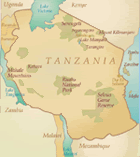
Hey can you find Tanzania on a map (or at least come close)?

It was great to be back home in America

There is nothing like the ease with which you slip back into your cultural homeland. Within a few days my hint of a New York accent came back. The salads and the Thai food were wonderful. The energy of New York, and even Baltimore, put a spring in my step. And I marvelled at all the wonderful innovations that have become commonplace in the past three years (especially the IPhone) that haven’t yet really made their way to Tanzania. (I thought I was cool now that I have a BlackBerry Pearl.) The kids pigged out on the Good Humour Man – every day – turning their faces the florescent colours of elaborate icicle pops. And being in the bosom of friends and family – people who have known me forever – felt great. I was happy to be there and felt engaged and at ease.

It is great to be back home in Tanzania

‘Nuff said.

Monday, June 29, 2009

Speaking of Misconceptions About Africa

True conversation with a Bank of America customer service representative just minutes ago...

Me: I live in Tanzania in East Africa and I have discovered some ATM fraud with my bank account which I’d like to report.

Service Rep: (With VERY strong southern accent) Now tell me, is it just beautiful over there?

Me: Parts of it sure are.

Service Rep: My mother-in-law has been trying to convince me to go over there to visit with her. She says she wants to run naked with the natives, but I told her that I’m not so comfortable with the idea of being naked with natives.

Me: Uh…I don’t think you’ll find people running naked these days. In fact, they are probably better dressed than you.

Service Rep: (Confused hesitation) Well… my mother-in-law died a few months ago anyway.

Me: Well good. Then perhaps I can report the ATM fraud?

Saturday, June 06, 2009

Survival Skills

I am in the US on “home leave”.

When I tell random strangers in America that I live in Tanzania I often get back a look that has now become familiar. It is actually more of a question than a look. The question is, “That girl, she lives in a hut?”

Just a few days ago I was at the bank in my childhood home of Larchmont, NY trying to explain to a teller why I needed to get a new ATM card early (my current one expires in 6 months). I told her that because I live overseas, in Africa, it will be difficult to get me my new one without a lot of headache (and since I don’t have a bank account there I am entirely dependant on the card). The teller and other people working behind the counter – and even some of my fellow clients - immediately began to pepper me with questions about my life there.

In particular, people always ask me about the amenities. On this day, the staff and clients of Bank of America couldn’t believe that I have a house not all that different than a house in Larchmont (ok, slight exaggeration – but when the water and electricity are working that is essentially true). They couldn’t believe that I live in a suburb that has much in common with Larchmont (again an exaggeration – but Larchmont has overpriced restaurants and supermarkets and one single movie theatre – just like in Dar).

I assured them that I do not live in a hut, I have indoor plumbing (five bathrooms on my property, actually), and my life is comfortable and mostly secure.

These revelations always blow them away. And I leave these discussions feeling a wee bit superior, patting myself on my back for having done my public service for the day – like I’m a walking Schoolhouse Rocks.

But actually… perhaps I am really doing them a disservice? What do I really want them to believe about Africa and my life there?

How can I explain the conundrum of the life I lead as a rich person in one of the poorest nations on earth without sounding smug or insensitive? How can I make them understand that if I had to live in a hut, I wouldn’t be there either? How can I explain that I want to make a difference, but not at the expense of too many of the creature comforts I’ve also worked hard to be able to afford myself?

Even writing this makes me feel trite. It is the clash of my development guilt vs. my inner JAP.

In my thesaurus search for words to describe the incongruity of my life as an American in Tanzania I come up with: paradox, disagreement, opposition, inconsistency, ambiguity, and conflict.

In truth I feel all of these feelings more profoundly when I’m back in America – when I am forced to explain how I live and what I am doing. When I’m in Tanzania, it all seems quite natural. I’m surrounded by people of all nationalities living the same way as me – in our bubble on the Peninsula.

In Tanzania, if you let it all in, you go crazy. I’ve seen it happen to many people.- and when it does, they can’t survive there. They had to go home, back to the West, where they can dial up or down the amount of global suffering they let in based upon how much international news they watch or whether the gossip magazines are covering a story about Angelina Jolie’s lasted humanitarian jaunt. Re-reading this paragraph I sound kind of snarky. I don’t mean to. I totally understand it. It could easily be me – especially if I wasn’t distracted by work

But I don’t want to go home yet. Or rather, since I feel at home in Tanzania, I’m not ready to leave my home of the last 3+ years. Not yet.

At the bank they also asked me when I plan to come back to America. That seems to be the most frequent question I get when I’m on leave – and not just from my mother. When I tell strangers and friends that I’m not sure when I’ll be done overseas they go sort of glassy-eyed. I don’t know what my exit-plan is. I know it will come – but just not yet.

I guess I am ok living in a state of ambiguity. I’ve become talented at dealing with the paradox - good enough that the guilt and the complete lack of fairness and equity in this world doesn’t hit me as hard as it probably should until I’m actually outside of Tanzania.

This is certainly nothing to be proud of. But it is how I have survived and thrived.


My house, not long after we moved in. It is nicely landscaped now.